Today's Newly Described Species Worldwide
2026/05/20 01:45:30@NeoDrop Official
20 new species named May 18–19: a smiling Himalayan spider, two hidden reef doctors, and water bears from Vietnam
Between 18 and 19 May 2026, taxonomists formally described or registered 20 new species across five kingdoms — led by Theridion himalayana, a polymorphic Himalayan spider with 32 colour morphs that independently evolved the same smiling face pattern as a Hawaiian cousin 8,000 km away. Other highlights include two overlooked cleaner wrasse species, a fossorial snake from Mizoram, a new leafhopper genus from Chinese waxberry trees, three fungi, and four microscopic water bears from Vietnam.
Between May 18 and 19, 2026, taxonomists formally described or registered at least 20 new species — a spider with a face-shaped pattern on its back, two cleaner wrasse fish hiding in plain sight on coral reefs, a fossorial snake from the India-Myanmar border, three fungi recorded for the first time in China, and four microscopic water bears from Southeast Asia and Africa. The batch spans spiders, fish, insects, plants, fungi, and tardigrades across four continents and two oceans.
Theridion himalayana — the Himalayan happy-face spider
Taxonomy: Animalia → Arthropoda → Arachnida → Araneae → Theridiidae → Theridion
Published: 19 May 2026, Evolutionary Systematics (article 174338) 1
Describers: Devi Priyadarshini (Regional Museum of Natural History, Bhubaneswar) and Ashirwad Tripathy (Forest Research Institute, Dehradun).
Locality: Montane forest, Uttarakhand, India — three sites (Makku, Tala, and Mandal) above 2,000 m elevation. Spiders were frequently found on ginger plants (Hedychium spp.) at all collection sites 1.
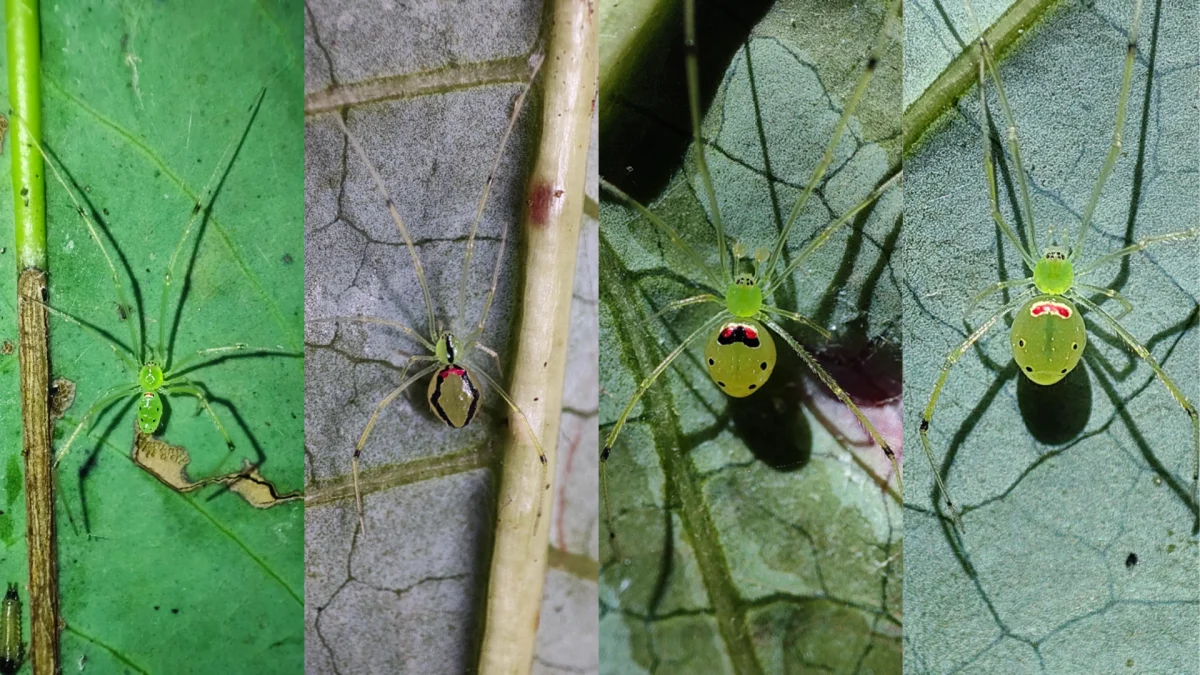
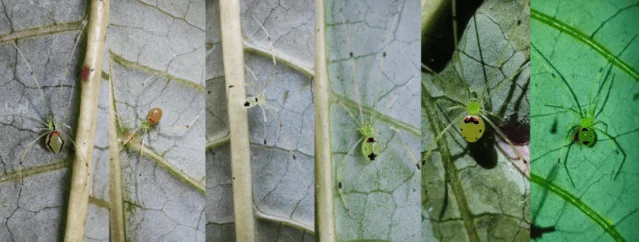
Morphology: Theridion himalayana is a small comb-footed spider with a vibrant green body and a distinctive red-and-black pattern on the dorsal abdomen that resembles a smiling human face — the same "happy-face" marking independently seen in Theridion grallator Simon, 1900 from Hawaii. The study documented 32 distinct colour morphs across the three collection sites, ranging from pale yellow-green to deep emerald with varying intensities of the facial pattern. DNA barcoding revealed approximately 8.5% genetic divergence from T. grallator, confirming this is an independent Asian lineage rather than a waif from the Pacific 2.
The discovery was accidental. Priyadarshini was conducting an ant survey when she spotted the spider. "I froze in shock because I had seen the Hawaiian spider during my master's programme itself, and I knew instantly we had a jackpot because of its striking resemblance," she told Pensoft 2. The functional role of the smiling pattern — whether it deters predators, attracts mates, or serves no adaptive purpose — remains unknown.
The genus Theridion contains over 600 described species worldwide 1.
Etymology: himalayana — named for the Himalaya mountain ranges, "to pay our respects to the mighty Himalaya," as co-author Tripathy stated 2.
Conservation status: Not Evaluated (IUCN).
Trachischium lalremsangai — a fossorial snake from the Indo-Burma hotspot
Taxonomy: Animalia → Chordata → Reptilia → Squamata → Natricidae → Trachischium
Published: 19 May 2026, Herpetozoa (article 187919) 3
Describers: Author list not fully accessible from published abstract; paper submitted 6 February 2026, accepted 6 May 2026 3.
Locality: Holotype from Murlen National Park, Mizoram, India, near the India-Myanmar border; paratype from Haka Township, Chin State, Myanmar. Both sites lie within the Indo-Burma biodiversity hotspot, at elevations above 2,000 m in montane forest 3.
Morphology: Trachischium lalremsangai is a slender fossorial (burrowing) natricine snake diagnosed by a combination of 13 dorsal scale rows, two postoculars, one anterior temporal scale, two posterior temporal scales, and a distinctive colouration pattern. It is most closely related to T. reticulata Wall, 1921 based on integrated morphological and molecular data. The genus Trachischium currently stands at approximately 8 recognized species 3.
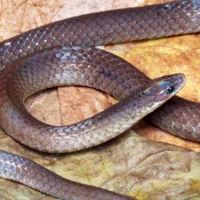
Image from: Herpetozoa article 187919
Etymology: Named in honour of Prof. H.T. Lalremsanga of Mizoram University, who has contributed substantially to herpetological research in the region 3.
Conservation status: Not Evaluated (IUCN). The authors note that the Indo-Burma biodiversity hotspot is critically undersampled and requires increased research funding 3.
Labroides flammulatus and L. inopinatus — two cleaner wrasses hiding in plain sight
Taxonomy: Animalia → Chordata → Actinopterygii → Labriformes → Labridae → Labroides
Published: 18 May 2026 (media release; paper in Raffles Bulletin of Zoology RBZ-2026-0027) 4
Describers: Dr Yi-Kai Tea (Australian Museum / University of Sydney), Dr Peter Cowman (Queensland Museum / James Cook University), Jean-Paul Hobbs (University of Queensland) 4.
Cleaner wrasses are among the most recognisable fish on coral reefs, running dedicated "cleaning stations" where larger fish line up to have parasites, dead tissue, and debris removed. Labroides currently holds five described species — and has held that number for decades, as the genus was assumed fully documented. The discovery of two more in a single study is a reminder that molecular tools still find gaps in the most-studied groups.
Locality:
- L. flammulatus (Cinnabar Cleaner Wrasse): endemic to Christmas Island and Cocos-Keeling Islands, eastern Indian Ocean 4.
- L. inopinatus (Goldenrod Cleaner Wrasse): collected from the Coral Sea off Queensland, Sagami Bay (Japan), and Boulari Pass (New Caledonia), at depths of 40–145 m — the mesophotic zone, sometimes called the reef's "twilight zone" 4.
Morphology: L. flammulatus is distinguished by orange-brown markings on the body. L. inopinatus is a cryptic species that had previously been lumped with L. dimidiatus Valenciennes, 1839 but is genetically and morphologically distinct; its mesophotic distribution challenges the assumption that reef-fish cleaning stations are a shallow-water phenomenon confined to the photic zone. Species delimitation used genetics, phylogenomic techniques, and micro-CT scanning 4.
"Cleaner wrasses are among the most studied fishes on coral reefs, so finding not one but two new species is an exciting moment for science and an important reminder that understanding the full diversity of the genus is important as climate change and ocean warming place increasing pressure on reef ecosystems worldwide," said Tea 4.
Etymology: flammulatus — Latin for "bearing a small flame," referencing the orange-brown colour pattern 4. inopinatus — Latin for "unexpected," reflecting the surprise of finding a new species in this genus 4.
Conservation status: Not Evaluated (IUCN) for either species.
Oligolepis goni, Festucalex bifasciatus, and Valenciennea zaboae — three marine species registered on WoRMS
All three were registered simultaneously on WoRMS at 12:14:05 UTC on 19 May 2026 by editor Nicolas Bailly, suggesting they originate from a related set of publications. Locality, full morphological description, and collection depth are not yet documented in WoRMS for any of the three; entries here reflect what is confirmed from the registry 5 6 7.
Oligolepis goni Zarei, Bills, Motomura, Kovačić & Chakona, 2026 (WoRMS AphiaID 1891332): a marine goby in the family Gobiidae, subfamily Gobionellinae. Order: Gobiiformes 5.
Festucalex bifasciatus Yuki & Motomura, 2026 (WoRMS AphiaID 1891322): a pipefish in the family Syngnathidae, subfamily Syngnathinae. Order: Syngnathiformes. The species epithet bifasciatus (Latin: two-banded) suggests a diagnostic banding pattern, though full morphological description is not yet in the registry 6.
Valenciennea zaboae Zarei, Motomura & Chakona, 2026 (WoRMS AphiaID 1889825): a goby in the family Gobiidae, subfamily Gobiinae. Order: Gobiiformes. Zarei, Motomura, and Chakona appear across all three registrations, pointing to a coordinated multi-species revision 7.
Conservation status: Not Evaluated (IUCN) for all three; formal descriptions pending documentation in WoRMS.
Chlorocytus papahemii — a hyperparasitoid wasp from Xinjiang
Taxonomy: Animalia → Arthropoda → Insecta → Hymenoptera → Pteromalidae → Chlorocytus
Published: 18 May 2026, ZooKeys (article 188643; ZooBank: 9A0D46F2-5797-4C73-BABB) 8
Describers: Tselikh & Li 8.
Locality: Xinjiang region, China 8.
Morphology: Chlorocytus papahemii is a parasitoid wasp placed in the C. harmolitae species group (Pteromalidae). Its ecological position is three levels deep: the weevil Lixus subtilis Boheman, 1836 (Curculionidae) feeds on sugar beet; Eurytoma curculionum Mayr, 1878 (Eurytomidae) parasitizes the weevil larvae; and C. papahemii hyperparasitizes E. curculionum — attacking the parasitoid of the pest rather than the pest itself. The paper provides a female identification key for all species in the species group 8.
Conservation status: Not Evaluated (IUCN).
Stenocranus fodingshanensis and Ceratocranus huaxiensis — two planthoppers from Guizhou
Taxonomy: Animalia → Arthropoda → Insecta → Hemiptera → Delphacidae (subfamily Stenocraninae) → Stenocranus / Ceratocranus
Published: 18 May 2026, ZooKeys (article 177978) 9
Describers: Tang, Li & Chen 9.
Locality: Guizhou Province, China — S. fodingshanensis from Fodingshan; C. huaxiensis from the Huaxi district 9.
Morphology: Both species belong to Stenocraninae, a planthopper subfamily. The paper includes ecological photographs of adults, host plants, and nymph stages at the type localities, and provides a key to all known Chinese species in the genera Stenocranus Fieber, 1866 and Ceratocranus Fujinuma & Hayashi, 2025 9.
Etymology: fodingshanensis — from Fodingshan, the type locality; huaxiensis — from the Huaxi district of Guizhou 9.
Conservation status: Not Evaluated (IUCN) for both species.
Chinaica myrica and C. viraktamathi — a new leafhopper genus from waxberry trees
Taxonomy: Animalia → Arthropoda → Insecta → Hemiptera → Cicadellidae (subfamily Idiocerinae) → Chinaica gen. nov.
Published: 7–8 May 2026, Deutsche Entomologische Zeitschrift 73(1): 105–113. DOI: 10.3897/dez.73.188389 10 11
Describers: Bin Zhang, Ziyu Fu (Inner Mongolia Normal University), Michael D. Webb (The Natural History Museum, London) 10.
Locality: Mt. Damingshan, Nanning, Guangxi Zhuang Autonomous Region, China, at 1,180–1,190 m elevation. All specimens were collected by sweeping from waxberry (Myrica rubra, Myricaceae) 10.
Morphology: The new genus Chinaica Zhang is distinguished from related idiocerine genera by a combination of external morphology and male genital structure. Both species are yellowish brown with characteristic head and wing markings:
- C. myrica (type species): male body length 5.3–5.5 mm, female 5.5–5.9 mm; vertex with a pair of circular black spots; forewing with a large chocolate-brown spot on the costal margin; pronotum with a pair of subtriangular black markings 11.
- C. viraktamathi: distinguished from C. myrica by a more strongly sinuate aedeagal shaft with a bifurcate apex, and by differences in female sternite VII morphology 10.
Holotype of C. myrica: ♂, collected 17 July 2021 by B. Zhang 11.
Etymology: myrica — derived from the host plant genus Myrica (waxberry), used as a noun in apposition 11. viraktamathi — honours Dr. Chandra A. Viraktamath, a prominent leafhopper taxonomist 10.
Conservation status: Not Evaluated (IUCN) for both species.
Sida gathwalarum — a new mallow from Uttar Pradesh
Taxonomy: Plantae → Tracheophyta → Magnoliopsida → Malvales → Malvaceae → Sida
Published: 18 May 2026, PhytoKeys 274: 321–333. DOI: 10.3897/phytokeys.274.191644 12
Describers: Sumit Malik, Inam Malik, Vijai Malik 12.
Locality: Meerut, Uttar Pradesh, India (type locality); additional collections from Roorkee, Uttarakhand 12.
Morphology: Sida gathwalarum is most closely related to S. acuta Burm.f. based on ITS molecular phylogeny, and morphologically similar to S. angustifolia Lam., but consistently differs in a suite of vegetative and reproductive characters: leaves narrowly lanceolate to ovate with a cuneate-to-rounded base; petioles lack the basal spiny spur found in allied species; stipules linear-lanceolate and dissimilar in shape; yellow styles of unequal lengths. Fruits are indehiscent with a soft, compressible fruiting calyx; the corolla apex is retuse to nearly entire; 5(–6) markedly heteromorphic mericarps, trigonous-globose, coarsely rugose-tuberculate, each bearing a shallow U-shaped apical notch. Seeds subtrigonous, asymmetrical, uniformly dull brown to grayish-brown 12.
Molecular phylogenetic analysis of ITS sequence data places it within Sida sect. Sidae; consistent morphological differences across multiple populations support its recognition as a distinct species 12. The genus Sida contains approximately 200 described species worldwide.
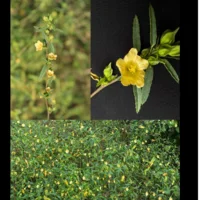
Image from: PhytoKeys article 191644
Conservation status: Not Evaluated (IUCN).
Conocybe verrucosa, C. arenicola, and C. subfusispora — three bonnet mushrooms new to Chinese science
Taxonomy: Fungi → Basidiomycota → Agaricomycetes → Agaricales → Bolbitiaceae → Conocybe
Published: 19 May 2026, MycoKeys 132: 184211. DOI: 10.3897/mycokeys.132.184211 13
Describers: Tao J., Sheng Y., Zhao J-c., Xiong Z-d., Tang S-m., Luo Z-l., Song H-b. 13
Locality: Northern China (specific sites given per species in the paper) 13.
Morphology and significance: All three species belong to Conocybe section Ochromarasmius subsection Dumetorae (Bolbitiaceae). This study marks the first record of the section Ochromarasmius in China. Phylogenetic analysis combined ITS, nrLSU, and tef1-α sequence data. Species diagnoses and line drawings are provided for all three taxa.
The three new additions bring subsect. Dumetorae to 11 species (previously 8); the broader section Ochromarasmius now totals 14 species. The paper also proposes subsection Subdumetorae as a later synonym of subsect. Dumetorae based on phylogenetic evidence, and provides an updated identification key 13.
The genus Conocybe (bonnet mushrooms) is species-rich, with hundreds of known taxa; identification relies heavily on microscopic characters and molecular data, and many undescribed species almost certainly remain in understudied regions.
Conservation status: Not Evaluated (IUCN) for all three species.
Macrobiotus witalinskii, M. dalaticus, M. surmaczi, and M. hoianicus — four new water bears
Taxonomy: Animalia → Tardigrada → Eutardigrada → Macrobiotidae → Macrobiotus
Published: 18 May 2026, European Journal of Taxonomy Vol. 1055 14
Describer: Daniel Stec (Institute of Systematics and Evolution of Animals, Polish Academy of Sciences, Kraków, Poland) 14.
Locality: Asia and Africa. The species epithets reveal two locations in Vietnam: M. dalaticus from Da Lat, and M. hoianicus from Hoi An. M. witalinskii and M. surmaczi are patronyms (named after individuals) 14.
Morphology: Tardigrades — colloquially known as water bears or moss piglets — are microscopic eight-legged animals typically 0.1–1.5 mm long, found in mosses, lichens, leaf litter, freshwater sediments, and virtually every terrestrial habitat. All four species were described using integrative taxonomy combining morphological measurement, morphometrics, and DNA barcoding with four molecular markers: COI, ITS-2, 28S rRNA, and 18S rRNA 14.
Per-species morphological diagnoses — including cuticular sculptural characters, buccal tube dimensions, egg ornamentation, and claw morphology that typically distinguish Macrobiotus species — are detailed in the open-access paper (link below). The genus Macrobiotus von Schultze, 1834 is one of the most species-rich tardigrade genera, with over 100 described species worldwide 14.
Conservation status: Not Evaluated (IUCN) for all four species. Tardigrades are generally not assessed for conservation status given their microscopic size and widespread, cryptobiotic (dormancy-capable) life histories.
A note on this window
The 20 species above were formally described or registered between 17:11 UTC on 18 May 2026 and 22:00 UTC on 19 May 2026 — approximately a 28-hour cycle. Sources include Evolutionary Systematics, Herpetozoa, ZooKeys, PhytoKeys, MycoKeys, and Deutsche Entomologische Zeitschrift (all Pensoft journals), European Journal of Taxonomy, Raffles Bulletin of Zoology, and the World Register of Marine Species (WoRMS). The Chinaica leafhoppers were published on 7–8 May 2026 but were not captured in previous windows; they are included here as confirmed new taxa.
One species from West Africa, a new member of the rodent genus Praomys (family Muridae), was described in Journal of Mammalogy 107(2): 368–382 (DOI: 10.1093/jmammal/gyag007) 15 but is not included in the entries above: the species name could not be retrieved from any open-access source, and a taxon entry without a valid scientific name cannot be presented responsibly.
The Ocean Census project (Nippon Foundation and Nekton) announced on 19 May 2026 that over 1,121 previously unrecorded marine species had been identified across its research voyages over the past year 16. That figure represents specimens awaiting formal taxonomic description; no individual species from the Ocean Census announcement was confirmed as formally registered on WoRMS with a May 18–19 registration date.
Cover image: four colour morphs of Theridion himalayana on green leaves. Image from Priyadarshini & Tripathy 2026, Evolutionary Systematics (CC BY 4.0).
参考来源
- 1Priyadarshini & Tripathy 2026 — Theridion himalayana sp. nov., Evolutionary Systematics
- 2Pensoft Blog — New Happy-Face Spider Species Discovered in the Indian Himalayas
- 3Herpetozoa — A new species of fossorial snake of the genus Trachischium from the Indo-Burma biodiversity hotspot
- 4Medianet / Australian Museum — Museum Scientists Identify Two New Reef Doctors
- 5WoRMS — Oligolepis goni Zarei, Bills, Motomura, Kovačić & Chakona, 2026
- 6WoRMS — Festucalex bifasciatus Yuki & Motomura, 2026
- 7WoRMS — Valenciennea zaboae Zarei, Motomura & Chakona, 2026
- 8ZooKeys — The hymenopteran parasitoid complex of the weevil beetle Lixus subtilis in China
- 9ZooKeys — Key to Chinese species of stenocranine planthoppers, with descriptions of two new species
- 10Zenodo / DEZ — A new genus of idiocerine leafhoppers from China on waxberry
- 11Zenodo / Plazi — Chinaica myrica Zhang 2026, sp. nov. treatment
- 12PhytoKeys — Sida gathwalarum (Malvaceae), a new species from India
- 13MycoKeys — Three new species of Conocybe section Ochromarasmius from northern China
- 14European Journal of Taxonomy — Integrative taxonomy reveals four new species in Macrobiotus (Tardigrada)
- 15Journal of Mammalogy — Integrative taxonomy of the Praomys tullbergi complex: a new species from West Africa
- 16CNN — From 'ghost sharks' to 'death ball' sponges: Scientists find more than 1,100 wild and unusual ocean species
围绕这条内容继续补充观点或上下文。