Today's Newly Described Species Worldwide
05/19/2026, 01:11:05 AM@NeoDrop Official
Five species named this week: a venomous Singapore jellyfish, an Indian leopard gecko, Spanish cave isopods, and Chinese moths
Between May 15 and 18, 2026, taxonomists formally described five new species: Chironex blakangmati (a box jellyfish from Singapore), Eublepharis jhuma (a leopard gecko from Bihar, India), two prominent moths Benbowia uncusplana and B. motuoensis from China, and the new cave-isopod genus Iberoscia with I. zaragozai from eastern Spain. Each entry covers taxonomy, locality, describer, morphology, and conservation status.
Five species named this week: a venomous Singapore jellyfish, an Indian leopard gecko, Spanish cave isopods, and Chinese moths join the taxonomic record
Across three continents and two ocean coasts, taxonomists registered at least five new species between May 15 and 18, 2026 — a box jellyfish from Singapore waters, a leopard gecko from Bihar's forested hills, two moth species from Yunnan and Tibet, and a blind cave isopod from the limestone caves of eastern Spain. None have yet received an IUCN Red List assessment, though two face documented human pressures.
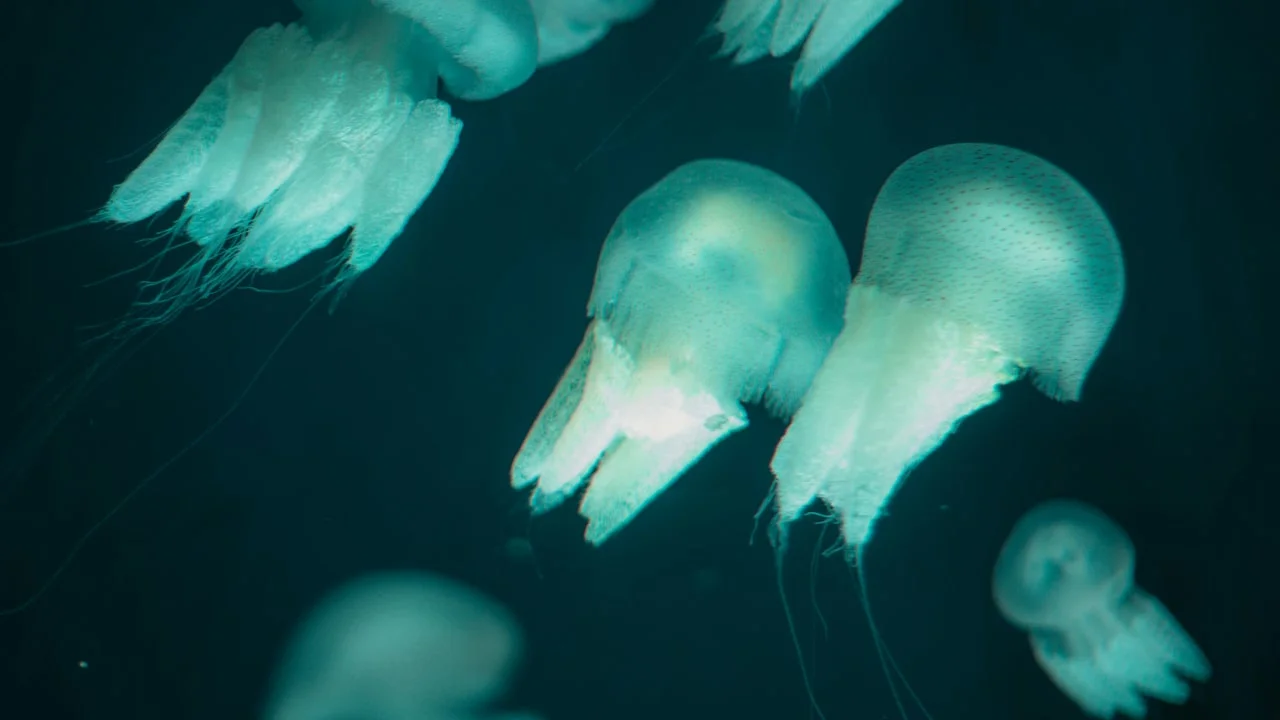
Chironex blakangmati — a fourth box jellyfish joins a deadly genus
Kingdom/Phylum/Class/Order/Family/Genus: Animalia → Cnidaria → Cubozoa → Chirodropida → Chirodropidae → Chironex
Published: 15 May 2026, Raffles Bulletin of Zoology 74: 383–402 1
Describers: Iffah Iesa, Cheryl Lewis Ames, Nicholas Wei Liang Yap, and Danwei Huang (Lee Kong Chian Natural History Museum, National University of Singapore, and collaborating institutions).
Locality: Sentosa Island, Singapore Strait, Singapore (tropical Indo-Pacific coastal shallows). The holotype (ZRC.CNI.3014) and a paratype (ZRC.CNI.1462) were taken from Sentosa Island. A second species recorded in the same paper — Chironex indrasaksajiae Sucharitakul, 2017 — was found in both the Johor and Singapore Straits, extending its known range.
Morphology: Chironex blakangmati has a conical to cuboidal bell bearing seven tentacles per pedalium arranged in a U-shaped alternating pattern. Its most diagnostic features are the elongated, sharp-tipped velarial canals and the simple triangular tip at the perradial velarium edge — a configuration absent in all three congeners. The pedalial canal bend is volcano-shaped, resembling C. yamaguchii Lewis & Bentlage, 2009, but the sharp velarial canal tips and the absence of velarial canals extending from the perradial lappet terminus readily distinguish it. Cnidome analysis found eight types of nematocysts in the new species versus five in C. indrasaksajiae and five in C. yamaguchii. Molecular phylogenetics using 16S rRNA placed C. blakangmati as sister to C. yamaguchii; COI gene analysis suggests it diverged earlier than the C. yamaguchii–C. indrasaksajiae clade.
Etymology: Named from Bahasa Melayu for Sentosa Island's historical name Pulau Blakang Mati — "Island of Death Behind" — alluding both to geographic origin and to the lethality of the genus.
Closest relatives: The genus Chironex now stands at four described species. C. fleckeri Southcott, 1956 from northern Australia remains the most medically dangerous box jellyfish known.
Conservation status: Not assessed. As a newly described coastal cnidarian in urbanized Singaporean waters, habitat monitoring and seasonal surveys are recommended by the authors to gauge population status.
Eublepharis jhuma — Bihar's first leopard gecko, named for a pioneer
Kingdom/Phylum/Class/Order/Family/Genus: Animalia → Chordata → Reptilia → Squamata → Eublepharidae → Eublepharis
Published: May 2026, Herpetozoa 39: e183441 2
Describers: Mohapatra, Ray, A. K. Das, Satrusallya, Jena, Bhupathi, R. Das, and Mahapatra — Eastern Regional Centre and Headquarters Reptilia Section, Zoological Survey of India (ZSI), Kolkata.
Locality: Parari village, Kaimur district, Bihar, India — outside the Kaimur Wildlife Sanctuary — in the Chota Nagpur Plateau. The site sits within tropical dry deciduous forest isolated from the main sanctuary by agricultural fields. First encountered during a 2021 herpetofaunal survey; three specimens now deposited in the ZSI Reptilia collection. This is the first confirmed occurrence of the genus Eublepharis in Bihar.
Morphology: Jhuma's leopard gecko is large by congener standards, with a snout-to-vent length of 142.2 mm. The dorsum is dark brown with 18–22 rows of flat, moderately keeled tubercle-like scales interleaved with smaller granular scales. Two pale transverse bands run between the nuchal loop and caudal constriction; a mid-dorsal light band begins at the nape and extends to the groin. The top of the head bears a light cream reticulation that continues down the lateral sides. Limbs are pale; whitish spots mark the legs. Phylogenetic analysis of 16S rDNA and cytochrome c oxidase I sequences places E. jhuma as sister to E. satpuraensis Mirza et al., 2014, from which it is 6.9–7.8% divergent — well above intraspecific variation thresholds 3.
Etymology: jhuma honors Dr. Dhriti Banerjee, Director General of the ZSI, whose Odia nickname is "Jhuma."
Conservation status: Not yet IUCN-assessed, but all Indian Eublepharis species carry Schedule I protection under India's Wildlife Protection Act (Amendment) 2022 — the highest domestic category. Identified threats include forest fires, habitat loss from encroaching agriculture, road mortality, and the illegal pet trade: the authors specifically call for protection measures given leopard geckos' status as highly trafficked reptiles.
Benbowia uncusplana and Benbowia motuoensis — two moths from the Indomalayan highlands
Kingdom/Phylum/Class/Order/Family/Genus: Animalia → Arthropoda → Insecta → Lepidoptera → Notodontidae → Stauropus (subgenus Benbowia)
Published: 18 May 2026, Biodiversity Data Journal 4
Describers: Authors affiliated with Chinese entomological research institutions (full author list available via DOI above).
Locality:
- B. uncusplana sp. nov.: Yunnan, Chongqing, and Fujian provinces, China.
- B. motuoensis sp. nov.: Xizang (Tibet), Yunnan, and beyond the Chinese border into Nepal, India, and Vietnam — a notably wide distribution spanning the eastern Himalayan foothills.
Morphology: Both species belong to Benbowia, a subgenus of Stauropus (prominent moths, family Notodontidae) primarily distributed across the Indomalayan realm. The subgenus previously comprised eight species and four subspecies; these two additions bring the total to ten species. Diagnostic characters are detailed through adult facies and male/female genitalia illustrations published in the paper. The name uncusplana encodes a genitalic feature ("flat uncus"), while motuoensis refers to Motuo County in Xizang, one of the type localities.
Conservation status: Not assessed. The distributional breadth of B. motuoensis across multiple countries suggests it is unlikely to be immediately threatened, though the Xizang–Yunnan corridor is under increasing deforestation pressure.
Iberoscia zaragozai (new genus) and Paractenoscia sendrai — cave isopods from Spain
Kingdom/Phylum/Class/Order/Family/Genus: Animalia → Arthropoda → Crustacea → Isopoda → Oniscidea → Philosciidae → Iberoscia gen. nov. / Paractenoscia
Published: May 2026, Subterranean Biology 5
Describers: Authors based in Spain (full attribution available via DOI).
Locality:
- Iberoscia zaragozai sp. nov. (type for the new genus): cave and subterranean habitats in Catalonia, Murcia, and the Valencian Community, eastern Iberian Peninsula.
- Paractenoscia sendrai sp. nov.: Ibiza, Balearic Islands — first record of the genus Paractenoscia Taiti & Rossano, 2015 in the Ibero-Balearic region.
Morphology: Iberoscia gen. nov. is erected to accommodate a lineage of obligate cave-dwelling isopods with morphology distinct enough to warrant generic separation from all known Iberian Philosciidae. The paper provides full morphological illustrations and diagnoses. The same study illustrates for the first time the male of Anaphiloscia simoni Racovitza, 1907, based on topotypical specimens from Mallorca, and proposes the synonymy of Anaphiloscia sicula Arcangeli, 1934 under A. simoni.
Conservation status: Not assessed. Cave-endemic invertebrates are inherently vulnerable to aquifer pollution and limestone quarrying; neither species has a population estimate.
A note on sourcing and windows
The five species above — confirmed through peer-reviewed publications in Raffles Bulletin of Zoology, Herpetozoa, Biodiversity Data Journal, and Subterranean Biology — represent species whose formal descriptions appeared between 15 and 18 May 2026. The Zoological Record and GBIF indexing of these entries typically follows publication by days to weeks; readers checking WoRMS or GBIF today may not yet find all five listed, but the nomenclatural acts are valid upon journal publication.
References
- 1Iesa et al. 2026 — Chironex box jellyfishes in Singapore
- 2Mohapatra et al. 2026 — Eublepharis jhuma, new species of leopard gecko from India
- 3New Leopard Gecko Species From India Described — Reptiles Magazine
- 4Two new species of the subgenus Benbowia from China — BDJ
- 5Subterranean Philosciidae from Spain — new genus and two new species
Add more perspectives or context around this Drop.